Machines that Understand Humans
How could you build a computer that understands humans?

My prior (naive) essay: General Personal Embeddings
Anthropic Recent Paper: Emotion Concepts
A few years ago, I fell in love with an idea. I wanted to understand myself. It was odd to me that no one understands themselves and that no one thinks about this problem. Self-understanding (or lack thereof) is one of the sharpest pain points of the human condition.
I don’t think a human will ever fully understand themselves. I do believe, however, that a machine will. And that the most human solution to this problem is to build that machine. Every year, machines prove an ability to understand a new domain better than humans. Within our lifetime, it is likely that we will create a machine with a superhuman ability to understand us.
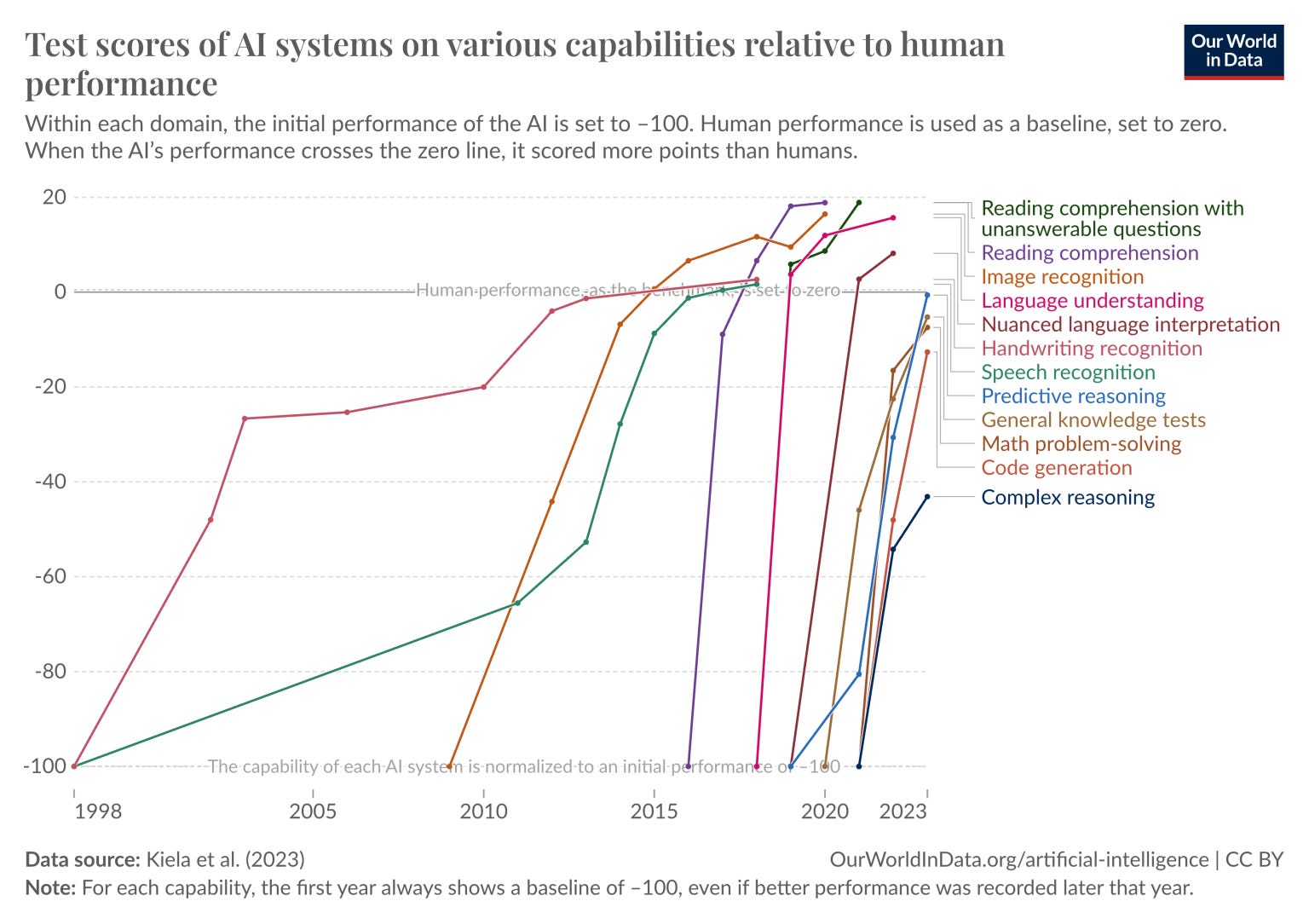
The question of how to build this machine is very difficult to answer, but there is no reason it is not a solvable problem. Given the implications of such a technology, it deserves deep examination. In fact, it’s my belief that this machine would be the most important invention in all of human history.
This is just me planting my flag. I don’t have time to fully write this at the moment, but I do want to start adding structure to come back to. The goal is to reason about how one might practically build such a machine. Exploring in detail all viable paths. I suspected that AI Memory was a core part of this problem, and I still do. Memory has become more fashionable in 2026. But it is a dead end if you really want to solve this problem.
I posit that if you can determine the optimal objective (knowing what to predict about a human, such as our next action) and have sufficient data, you could build this machine.
Introduction
What is intelligence?
How does a computer understand things?
Why does a computer understand things?
How might a computer understand humans?
How this shows up in science fiction
How would you create a computer that understands humans is the wrong objective. The correct objective is analogous to ChatGPT. How do you create AGI? You want a system that can predict the next word. It turns out that in order to predict the next word really well, you need to be really smart and understand the world.
Example of the murder plot. At the end of a crime drama the text reads, and the killer is ______. A truly intelligent system does this.
ChatGPT proved the pattern (intelligence fell out of next-word prediction); the open question is what the analogous objective is for humans, and whether the data for it even exists.
Representation as a means to an end.
The end is what matters. Human representations will be formed through a computer’s alien self-learning to accomplish an objective/task. And after, you could direct those representations to other general tasks. If you can represent it, you can simulate it, and if you can simulate it you can generate it.
Commercial History
History of personal computing
What is the core of how we use computers to help us?
MIT Textbook reference on Recommender Systems. ChatGPT in many ways falls under the definition of a recommendation system.
The Holy Grail of Recommender Systems. Achieving hyper-personalization through perfect serendipity
Advertisements
ChatGPT
Personalized AI (i.e. AI Therapists)
AI Memory
Boardy, Matchmaking
Human Simulations
Summary: much of our interaction with software is already personalized. And that if we really understand this trend, it is only becoming more so. It’s still day 1.
Literature Review
Recommender Systems
Content based to collaborative filtering
Wide and Deep Recommendation Systems
TIGER and Deep NN
Generative Recommendations
Scaling Laws
The No Free Lunch Theorem
Theoretical upper limit of embedding based retrieval and Curse of Dimensionality
Federated Learning
AI Memory (comprehensive overview)
Generative Agents
General User Models
Core Gaps
Data signals & Landscape
Data is so important for understanding everything around this problem. It is upstream of everything.
Genetic data, descriptive, action, etc. What is the exhaustive account of what data on us exists.
Tabular vs Token
Data as fossil fuel. What data exists and how much of it? What data might we need to create and how would you?
Alignment and Structured Ontology vs align meaning
It is interesting that global text has signals that a computer can learn about humanity from. We need to ask questions about what other data exists in the world that we can create a solution for.
Potential Objectives? (This is probably the most important section in the paper and deserves rigor).
We don’t actually know the answer to this.
Verifiability?
Shallow objectives and the failure case of the wrong objective. Slop.
Some candidates and what are the sub-objectives
Matching
Recommendations
Personalized AI
Next-action prediction
Simulation
Simulation feels like the abstract version of computers that understand humans. And maybe it’s the case that this would be solved first. Or maybe in order to really solve it, you need to precisely understand each individual human that composes the abstraction. Maybe each individual human is difficult to predict. But on the order of populations, it averages out.
World Models
The failure of purely probabilistic systems
What is the actual success here and what can we learn about the success and failure cases for non-LLM foundation models
Market Landscape and Deep Examination of Existing Approaches
Model Layer
Simile AI
Unbox AI
Humans&
Aaru
Data Layer
Not sure
Dev Tools
AI Memory Players
Shaped AI
App Layer
Many of the personalized AI players
Notably, much of large tech exists in a state of being the app and data and model layer. Walled gardens.
Assuming you solve the data and objective problem. What does that mean? From an objective side, you would have much better product recommendations. But of course we should not view ChatGPT as better word prediction. What happens in that process is you have developed a machine that understands the world in the case of ChatGPT and you would understand humans in the case of this.
How one could realistically approach this problem
Data should be viewed as relatively unchangeable fossil fuel
The one thing you could try to reason about is the objective
The historical objectives we have built systems around are quite trodden
What might be an example of a new objective?
The question with ChatGPT turned away from what you could do with better word prediction. But what you could do with an approximation of intelligence. Or with high-fidelity representations of the world. Could you do the same with not only an approximation of understanding humans, but actually understanding humans better than any human?
What could you do with that
I simply do not know and it is impossible for any human to know
Self-understanding itself is one of the sharpest pain points of the human condition
Perfect Search and relationship simulation
Perfect Therapist / Perfect Mentor
Complete loss of human agency
Match you to the perfect person on earth. Perfect Job. And tell you why.
Bad actors and addictive programming. Market incentives.
I almost want to treat this section as saying roughly, “I don’t know why it will be important, but if aliens arrived on humans and they understood us better than we understood ourselves, don’t you think that deserves examination?”